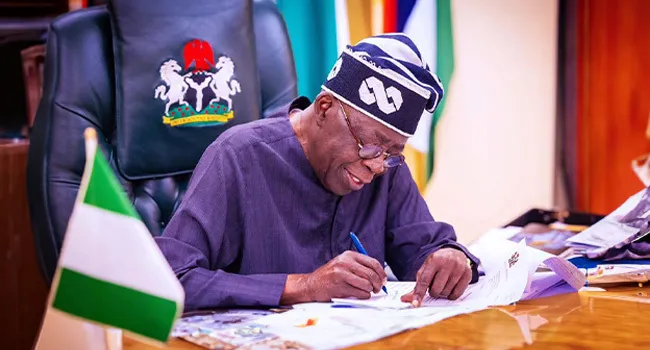
President Bola Tinubu’s wave of presidential pardons has triggered widespread outrage across Nigeria, particularly on social media platforms such as X (formerly Twitter). Many Nigerians view the gesture as another example of selective justice; one that exposes the widening gulf between the privileged and the powerless in Nigeria’s criminal justice system.
The president’s decision to pardon convicts such as Maryam Sanda, sentenced to death for killing her husband, and several others convicted for drug-related, corruption and homicide offences, has unsettled public confidence in the government’s sense of moral and judicial responsibility. While the constitution empowers the president to exercise the prerogative of mercy, the wisdom and fairness guiding such discretion are now being fiercely questioned.
Selective Compassion in a completely Broken Justice System
Nigeria’s prisons are filled with thousands of people who have not been tried, let alone convicted. According to credible reports, over 70 per cent of inmates are awaiting trial, some languishing behind bars for years over minor offences, or for crimes they did not commit. Many are victims of police incompetence, prosecutorial delay, or outright injustice.
Yet, rather than directing state compassion toward this neglected population, the presidency has chosen to extend mercy to those already convicted of grievous crimes. This glaring moral inversion betrays a justice system that is already broken and biased.
Corruption and the Question of Credibility
Farouk Lawan, former chairman of the House of Representatives’ Ad-Hoc Committee on Fuel Subsidy, was caught soliciting a $500,000 bribe from billionaire Femi Otedola to remove his company from a list of alleged subsidy scam beneficiaries. Lawan’s actions were a betrayal of public trust and a reminder that the corridors of power remain fertile ground for greed and corruption. When the presidency extends pardon to convicts of corruption like Lawal, while countless innocent souls languish in prison, it risks reinforcing the dangerous perception that justice in Nigeria is selective; reserved for the connected, and denied to the powerless. With the 2027 elections fast approaching, this pardon appears to be a calculated political maneuver to win support in the North.
The Maryam Sanda Case
The most contentious of these pardons is that of Maryam Sanda, who was convicted in 2020 for the murder of her husband, Bilyaminu Bello, the son of a prominent political family. Her death sentence was upheld by the courts, following due legal process.
By granting her a pardon, the presidency has sent a confusing message to the public: that violent crime can be excused, provided one enjoys public sympathy or elite proximity. Such selective mercy diminishes the value of justice and dishonours the memory of the victim. It also undermines the tireless efforts of judges, prosecutors and law-enforcement officers who work to uphold the rule of law in a country already battling with impunity.
A Questionable Approach to Historical Justice
The posthumous pardon granted to Ken Saro-Wiwa and the Ogoni Nine, executed in 1995, was presented as a gesture of national healing. But critics rightly argue that a pardon still implies guilt. What the Ogoni activists deserve is exoneration, not forgiveness. Their wrongful execution by a dictatorial regime demands acknowledgment of innocence, not clemency. The distinction is fundamental to the integrity of justice. By issuing a pardon instead of a full exoneration, the government has again demonstrated a lack of understanding of what genuine reconciliation and accountability require.
The Wrong Signal to a Wounded Nation
In a country where corruption thrives and crime remains rampant, the Nigerian government must be careful about the signals it sends. When citizens convicted of murder, drug trafficking, or embezzlement receives state mercy, it erodes deterrence and weakens public faith in the law.
For countless Nigerians unjustly detained, it is unfortunate that justice in their country is not blind; it sees class, influence, and connection. Their pain and deprivation are ignored, while the powerful or prominent are absolved under the guise of compassion.
Such inequitable administration of mercy threatens to reduce the rule of law to a tool of convenience. Justice must not only be done; it must be seen to be done. Anything less fuels cynicism and emboldens wrongdoing.
What the Presidency Should Have Done
overnment would have focused its mercy where it is most needed, on the voiceless and the forgotten. Instead of shielding the convicted elite, the Tinubu administration should urgently review the cases of thousands of awaiting-trial inmates, many of whom have never seen a courtroom.
The government should also make the Clemency Committee’s criteria public, to ensure transparency and restore credibility. Clemency should follow justice, not replace it. The president’s advisers must understand that national healing cannot be achieved through arbitrary forgiveness but through equitable accountability.
Conclusion
President Tinubu’s pardon exercise reflects poor judgment and misplaced empathy. While mercy remains an important instrument of governance, it must not be applied in ways that mock justice or deepen social inequality. The presidency should remember that a nation cannot build peace on the graves of fairness.
Until Nigeria’s leadership learns to balance compassion with accountability, the scales of justice will remain tilted, not toward mercy, but toward impunity.